Ultimate Christmas Pudding
by Nigella. Featured in NIGELLA CHRISTMASIntroduction
 I don’t deny it: there is something unattractively boastful about calling one’s own recipe “ultimate”. But having soaked my dried fruit for this pudding in Pedro Ximénez — the sweet, dark, sticky sherry that has a hint of liquorice, fig and treacle about it — I know there is no turning back. It’s not even as if it’s an extravagance: the rum or brandy I’ve used up till now are more expensive and do the trick less well. This is sensational — it is the Queen of Christmas puddings. It has to be tried, and clamours to be savoured.
I know that many of you, tradition be damned, are resistant to Christmas pudding, and I do understand why. But you must try this. For until you do, you probably think all that dried fruit is, well, dry, and the pudding heavy. Yet this is far from the case: the fruit is moist and sticky, and the pudding mystifyingly, meltingly light.
And please read the Additional Information section at the end of the recipe before proceeding.
I don’t deny it: there is something unattractively boastful about calling one’s own recipe “ultimate”. But having soaked my dried fruit for this pudding in Pedro Ximénez — the sweet, dark, sticky sherry that has a hint of liquorice, fig and treacle about it — I know there is no turning back. It’s not even as if it’s an extravagance: the rum or brandy I’ve used up till now are more expensive and do the trick less well. This is sensational — it is the Queen of Christmas puddings. It has to be tried, and clamours to be savoured.
I know that many of you, tradition be damned, are resistant to Christmas pudding, and I do understand why. But you must try this. For until you do, you probably think all that dried fruit is, well, dry, and the pudding heavy. Yet this is far from the case: the fruit is moist and sticky, and the pudding mystifyingly, meltingly light.
And please read the Additional Information section at the end of the recipe before proceeding.

Ingredients
Yields: 8-10 servings
- 150 grams currants
- 150 grams sultanas
- 150 grams roughly chopped prunes
- 175 millilitres pedro ximenez sherry
- 100 grams plain flour
- 125 grams fresh breadcrumbs
- 150 grams suet
- 150 grams dark brown muscovado sugar
- 1 teaspoon ground cinnamon
- ¼ teaspoon ground cloves
- 1 teaspoon baking powder
- grated zest of 1 unwaxed lemon
- 3 large eggs
- 1 medium cooking apple (peeled and grated)
- 2 tablespoons honey
- 125 millilitres vodka (to flame the pudding)
- 1¼ cups Zante currants
- 1 cup golden raisins
- 1 cup roughly chopped pitted prunes
- ¾ cup pedro ximenez sherry
- ⅔ cup all-purpose flour
- 2⅓ cups fresh breadcrumbs
- 14 tablespoons coarsely grated vegetable shortening (freeze overnight to make it easier to grate)
- ¾ cup dark brown sugar
- 1 teaspoon ground cinnamon
- ¼ teaspoon ground cloves
- 1 teaspoon baking powder
- grated zest of 1 unwaxed lemon
- 3 large eggs
- 1 medium apple (peeled and grated)
- 2 tablespoons honey
- ½ cup vodka (to flame the pudding)

Method
You will need a 1.7 litre/3 pint/1½ quart heatproof plastic pudding basin with a lid, and also a sprig of holly to decorate.
- Put the currants, sultanas and scissored prunes into a bowl with the Pedro Ximénez, swill the bowl a bit, then cover with clingfilm and leave to steep overnight or for up to 1 week.
- When the fruits have had their steeping time, put a large pan of water on to boil, or heat some water in a conventional steamer, and butter your heatproof plastic pudding basin (or basins), remembering to grease the lid, too. For instructions on using a pressure cooker, see the additional information section below.
- In a large mixing bowl, combine all the remaining pudding ingredients (except the vodka), either in the traditional manner or just any old how; your chosen method of stirring, and who does it, probably won’t affect the outcome of your wishes or your Christmas.
- Add the steeped fruits, scraping in every last drop of liquor with a rubber spatula, and mix to combine thoroughly, then fold in cola-cleaned coins or heirloom charms. If you are at all frightened about choking-induced fatalities at the table, do leave out the hardware.
- Scrape and press the mixture into the prepared pudding basin, squish it down and put on the lid. Then wrap with a layer of foil (probably not necessary, but I do it as I once had a lid-popping and water-entering experience when steaming a pudding) so that the basin is watertight, then either put the basin in the pan of boiling water (to come halfway up the basin) or in the top of a lidded steamer (this size of basin happens to fit perfectly in the top of my all-purpose pot) and steam for 5 hours, checking every now and again that the water hasn’t bubbled away.
- When it’s had its 5 hours, remove gingerly (you don’t want to burn yourself) and, when manageable, unwrap the foil, and put the pudding in its basin somewhere out of the way in the kitchen or, if you’re lucky enough, a larder, until Christmas Day.
- On the big day, rewrap the pudding (still in its basin) in foil and steam again, this time for 3 hours. Eight hours combined cooking time might seem a faff, but it’s not as if you need to do anything to it in that time.
- To serve, remove from the pan or steamer, take off the lid, put a plate on top, turn it upside down and give the plastic basin a little squeeze to help unmould the pudding. Then remove the basin — and voilà, the Massively Matriarchal Mono Mammary is revealed. (Did I forget to mention the Freudian lure of the pudding beyond its pagan and Christian heritage?)
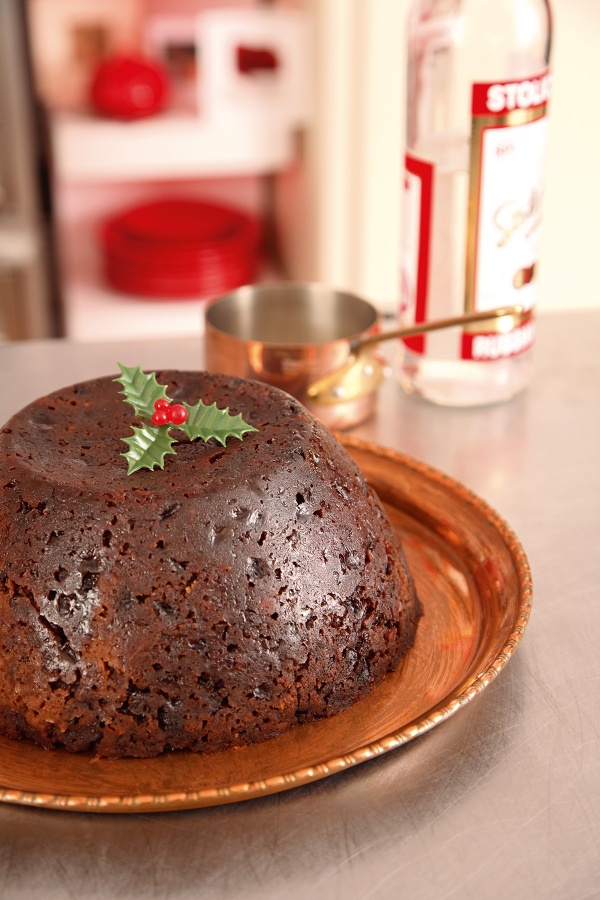
- Put the sprig of holly on top of the dark, mutely gleaming pudding, then heat the vodka in a small pan (I use my diddy copper butter-melting pan) and the minute it’s hot, but before it boils — you don’t want the alcohol to burn off before you attempt to flambé it — turn off the heat, strike a match, stand back and light the pan of vodka, then pour the flaming vodka over the pudding and take it as fast as you safely can to your guests. If it feels less dangerous to you (I am a liability and you might well be wiser not to follow my devil-may-care instructions), pour the hot vodka over the pudding and then light the pudding. In either case, don’t worry if the holly catches alight; I have never known it to be anything but singed.
- Serve with the Eggnog Cream, which you can easily make — it's the work of undemanding moments — while the pudding's steaming.
You will need a 1.7 litre/3 pint/1½ quart heatproof plastic pudding basin with a lid, and also a sprig of holly to decorate.
- Put the Zante currants, golden raisins and scissored pitted prunes into a bowl with the Pedro Ximénez, swill the bowl a bit, then cover with clingfilm and leave to steep overnight or for up to 1 week.
- When the fruits have had their steeping time, put a large pan of water on to boil, or heat some water in a conventional steamer, and butter your heatproof plastic pudding basin (or basins), remembering to grease the lid, too. For instructions on using a pressure cooker, see the additional information section below.
- In a large mixing bowl, combine all the remaining pudding ingredients (except the vodka), either in the traditional manner or just any old how; your chosen method of stirring, and who does it, probably won’t affect the outcome of your wishes or your Christmas.
- Add the steeped fruits, scraping in every last drop of liquor with a rubber spatula, and mix to combine thoroughly, then fold in cola-cleaned coins or heirloom charms. If you are at all frightened about choking-induced fatalities at the table, do leave out the hardware.
- Scrape and press the mixture into the prepared pudding basin, squish it down and put on the lid. Then wrap with a layer of foil (probably not necessary, but I do it as I once had a lid-popping and water-entering experience when steaming a pudding) so that the basin is watertight, then either put the basin in the pan of boiling water (to come halfway up the basin) or in the top of a lidded steamer (this size of basin happens to fit perfectly in the top of my all-purpose pot) and steam for 5 hours, checking every now and again that the water hasn’t bubbled away.
- When it’s had its 5 hours, remove gingerly (you don’t want to burn yourself) and, when manageable, unwrap the foil, and put the pudding in its basin somewhere out of the way in the kitchen or, if you’re lucky enough, a larder, until Christmas Day.
- On the big day, rewrap the pudding (still in its basin) in foil and steam again, this time for 3 hours. Eight hours combined cooking time might seem a faff, but it’s not as if you need to do anything to it in that time.
- To serve, remove from the pan or steamer, take off the lid, put a plate on top, turn it upside down and give the plastic basin a little squeeze to help unmould the pudding. Then remove the basin — and voilà, the Massively Matriarchal Mono Mammary is revealed. (Did I forget to mention the Freudian lure of the pudding beyond its pagan and Christian heritage?)
- Put the sprig of holly on top of the dark, mutely gleaming pudding, then heat the vodka in a small pan (I use my diddy copper butter-melting pan) and the minute it’s hot, but before it boils — you don’t want the alcohol to burn off before you attempt to flambé it — turn off the heat, strike a match, stand back and light the pan of vodka, then pour the flaming vodka over the pudding and take it as fast as you safely can to your guests. If it feels less dangerous to you (I am a liability and you might well be wiser not to follow my devil-may-care instructions), pour the hot vodka over the pudding and then light the pudding. In either case, don’t worry if the holly catches alight; I have never known it to be anything but singed.
- Serve with the Eggnog Cream, which you can easily make — it's the work of undemanding moments — while the pudding's steaming.
Additional Information
If you do want to use an Instant Pot or a pressure cooker then you should put the pudding batter into the prepared pudding basin, put a circle of baking parchment (parchment paper) on top and then wrap the basin tightly in a double layer of clingfilm (plastic wrap) and a layer of foil, sealing each layer tightly. Don't use a clip-on lid as this will pop off when cooking under pressure. It is best to steam the pudding in the conventional way for 20 minutes first, as this activates the baking powder and gives a slightly lighter pudding. Once the pudding has had its initial steaming, put it on a trivet in the pressure cooker and add water to come 2cm/1 inch up the sides of the basin. Close the valve and cook under high pressure for 2 hours. Use natural release to reduce the pressure to a safe level before opening the cooker and removing the pudding. Let the pudding cool and once cold remove the wrapping and baking parchment, replace with fresh baking parchment and wrap again with a double layer of fresh clingfilm and a layer of foil, sealing each layer tightly. Store in a cool, dry place. To reheat the pudding, put it back on a trivet in the pressure cooker, add enough water to come 2cm/1 inch up the sides of the basin and cook under full pressure for 40 minutes. If you have an Instant Pot then you can use the "keep warm" function afterwards to keep the pudding warm until you are ready to serve it.
Although I stipulate a capacious 1.7 litre/3 pint/1½ quart basin, and cannot extol the utter gloriousness of this pud too much, I know that you’re unlikely to get through most of it, even half of it, at one sitting. But I like the grand, pride instilling size of this, plus it’s wonderful on following days, microwaved in portionsafter or between meals, with leftover Eggnog Cream, or fried in butter and eaten with vanilla ice cream for completely off-the-chart, midnight-munchy feasts. But it wouldn’t be out of the question — and it would certainly be in the spirit of the season — to make up the entire quantity of mixture, and share between smaller basins — a 2 pint/1 quart one for you, a 1 pint/½ quart one to give away. Three hours’ steaming both first and second time around should do it; just keep the one pudding for yourself, and give the other to a friend, after it’s had its first steaming, and is cool, with the steaming instructions for Christmas Day.
MAKE AHEAD:
Make the Christmas pudding up to 6 weeks ahead. Keep in a cool, dark place, then proceed as recipe on Christmas Day.
FREEZE AHEAD:
Make and freeze the Christmas pudding for up to 1 year ahead. Thaw overnight at room temperature and proceed as recipe on Christmas Day.
If you prefer to reheat your pudding in a microwave on Christmas Day then make sure that you don’t put any coins or metal charms in the pudding. Steam the pudding for 8 hours then cool and store it. To reheat in a microwave (for an 800W oven), loosen the lid of the basin slightly or wrap the basin in clingfilm/plastic wrap and poke a couple of holes in the top (do not put any foil in the microwave). Microwave on full power for 4 minutes, stand for 3 minutes, microwave on low for 7 minutes and stand for 5 minutes. This should be enough to warm the pudding through but check by inserting a metal skewer into the centre of the pudding and then very carefully touch the end of the skewer on your wrist. The tip should feel hot. If it is not hot then microwave on full power for 1 minute, stand 1 minute and check again. Repeat until the pudding is piping hot all the way to the centre. Foods should only be reheated once, so we do not advise reheating leftovers
If you do want to use an Instant Pot or a pressure cooker then you should put the pudding batter into the prepared pudding basin, put a circle of baking parchment (parchment paper) on top and then wrap the basin tightly in a double layer of clingfilm (plastic wrap) and a layer of foil, sealing each layer tightly. Don't use a clip-on lid as this will pop off when cooking under pressure. It is best to steam the pudding in the conventional way for 20 minutes first, as this activates the baking powder and gives a slightly lighter pudding. Once the pudding has had its initial steaming, put it on a trivet in the pressure cooker and add water to come 2cm/1 inch up the sides of the basin. Close the valve and cook under high pressure for 2 hours. Use natural release to reduce the pressure to a safe level before opening the cooker and removing the pudding. Let the pudding cool and once cold remove the wrapping and baking parchment, replace with fresh baking parchment and wrap again with a double layer of fresh clingfilm and a layer of foil, sealing each layer tightly. Store in a cool, dry place. To reheat the pudding, put it back on a trivet in the pressure cooker, add enough water to come 2cm/1 inch up the sides of the basin and cook under full pressure for 40 minutes. If you have an Instant Pot then you can use the "keep warm" function afterwards to keep the pudding warm until you are ready to serve it.
Although I stipulate a capacious 1.7 litre/3 pint/1½ quart basin, and cannot extol the utter gloriousness of this pud too much, I know that you’re unlikely to get through most of it, even half of it, at one sitting. But I like the grand, pride instilling size of this, plus it’s wonderful on following days, microwaved in portionsafter or between meals, with leftover Eggnog Cream, or fried in butter and eaten with vanilla ice cream for completely off-the-chart, midnight-munchy feasts. But it wouldn’t be out of the question — and it would certainly be in the spirit of the season — to make up the entire quantity of mixture, and share between smaller basins — a 2 pint/1 quart one for you, a 1 pint/½ quart one to give away. Three hours’ steaming both first and second time around should do it; just keep the one pudding for yourself, and give the other to a friend, after it’s had its first steaming, and is cool, with the steaming instructions for Christmas Day.
MAKE AHEAD:
Make the Christmas pudding up to 6 weeks ahead. Keep in a cool, dark place, then proceed as recipe on Christmas Day.
FREEZE AHEAD:
Make and freeze the Christmas pudding for up to 1 year ahead. Thaw overnight at room temperature and proceed as recipe on Christmas Day.
If you prefer to reheat your pudding in a microwave on Christmas Day then make sure that you don’t put any coins or metal charms in the pudding. Steam the pudding for 8 hours then cool and store it. To reheat in a microwave (for an 800W oven), loosen the lid of the basin slightly or wrap the basin in clingfilm/plastic wrap and poke a couple of holes in the top (do not put any foil in the microwave). Microwave on full power for 4 minutes, stand for 3 minutes, microwave on low for 7 minutes and stand for 5 minutes. This should be enough to warm the pudding through but check by inserting a metal skewer into the centre of the pudding and then very carefully touch the end of the skewer on your wrist. The tip should feel hot. If it is not hot then microwave on full power for 1 minute, stand 1 minute and check again. Repeat until the pudding is piping hot all the way to the centre. Foods should only be reheated once, so we do not advise reheating leftovers


Tell us what you think
Thank you {% member.data['first-name'] %}.
Explore more recipesYour comment has been submitted.
What 66 Others have said
-
Posted by katzenfinch on 11th January 2026
-
Posted by ZeroZero on 29th December 2024
-
Posted by Dave58 on 24th November 2024
-
Posted by DevonJames on 31st December 2023
-
Posted by MsKaren on 28th December 2023
-
Posted by Bagpuss1316 on 18th December 2023
-
Posted by AAA123 on 28th November 2023
-
Posted by TWH70 on 3rd October 2021
-
Posted by Rosiecooks22 on 20th November 2020
-
Posted by Leeceloulou on 26th September 2020
-
Posted by Bakingqueen64 on 27th December 2019
-
Posted by Chattycat on 27th December 2019
Show more commentsThe holiday season of 2025 marked the fifth time I’ve made this, and this year I made two. We consumed one for a birthday celebration last night, and it was the best one ever. I used a Mrs. Anderson’s pudding mold to make it and a Laphroaig Quarter Cask to flame it and it was divine. Served it with a rich vanilla ice cream.
Thankyou this was stunning. And I say so with confidence as my mother used to make the best christmas puddings ever. I added 1/2 tsp grnd nutmeg + 1 tspn grnd allspice. I had extra breadcrumbs, 2 tablspns, and just added it in. I used dried cranberries + tart cherries instead of the prunes as I had them in the cupboard.
I made this last week, in 1/3 quantity, for the third Christmas running. I like nuts in chrissie pud, and peel, so sacrificed some of the vine fruits. I also reduce the suet a little. Although I use a pressure cooker to steam it, I don't add the weights - the cooker just reduces water loss and is generously large. Cooking at pressure produces a denser pud. Unlike shop-bought pud's, which I have kept for over a year and found to be absolutely fine, this must be frozen or eaten within 6-8-10 weeks of cooking.
I made the full size 3 pint version of this recipe. Instead of the sherry I substituted a 50/50 mux of port and brandy which was good. I also added a handful od coarsely chopped pecan nuts which gave a bit of extra texture and I'd thoroughly recommend. I knew that I wanted to reheat on Christmas Day in the microwave so steamed it for the full 8 hours. Next year I will reduce that by about half an hour as I thought the pudding was just starting to dry out a bit. Despite that, everyone loved it and more pudding was eaten than ever before in our family. Everyone agreed that the pudding was just right for sweetness and not too sweet like Christmas puddings often are. A great success and I'll be making it again next November. Thank you Nigella.
I’ve not made my own Christmas pudding for years as I don’t like them that much. However, seeing as this one is “ultimate” I thought I’d give it a go and am totally converted. Really delicious and enjoyable. Will definitely make it again.
I made this gluten free and vegan using the suggestions given - gluten free flour mixed with ground almonds and chickpea water….. it was fantastic!!!! My family all preferred it to the “normal” version I had made previously. It was lighter than a traditional pudding which was very pleasant. I am going to make this version every year from now on!
I make this every year using approx 2/3 quantities (because of the eggs). I put this in two 500ml screw top rubbermaid plastic pots and steam in a slow cooker, on high till boiling then low for around 5 hours with a small cloth under so they are not sitting directly on the base of the pot. This works really well and I just microwave when needed. The puddings are very light, so much better that store bought. I have decided to ignore any plastic leaching worries, instead going for the convenience- your call. This is the only thing I use a slow cooker for!
I tried this recipe for the first time a few days ago, by making a half size of this to see how it would taste - and it’s genuinely delicious!! Having tasted it over a few days where it kept improving, I’m definitely going to make the one for Christmas a month ahead and then hide it, so we’re not tempted to snaffle it any earlier! I did make a couple of small changes for taste as follows: replaced sultanas with cherries, swapped cloves for ground allspice and used black treacle in place of honey. For info, although I halved the ingredients to make a pudding for a 0.9 litre basin, I didn’t quite halve the cooking time, so it was steamed for 5 hours in total. Reheating in the microwave has worked really well too. This is bliss in a pudding basin and brilliantly easy to make!
This recipe is fabulous, i'm not even that keen on Christmas pudding, but this will change your mind !!! And from experience use pedro ximenez sherry, it really makes a difference, I tried a different alcohol last year, which was a disappointment. Nigella is the one cook I can rely on, her recipes just work. Thank you Nigella
I made multiple of these with my pressure cooker last year. My family has already requested another for this year. If you can get a hold of some Pedro Ximénez, do it! It makes all the difference.
Made this back in November. I made one for my family and gave one away to family. What a fantastic recipe. Nigella recipes never fail and this was no exception. Everyone loved it and gave rave reviews. None left. This will be on the menu for every Christmas now.
It wasn't that hard to make. I steamed it in a metal pudding basin. Nice and soft. There was no intense spice flavours. Well balanced pudding. The best I have had. The other one is from the shops. Just the steaming time is the only issue if it is at all. I took it with me on a domestic flight. Steamed the rest of it the day before and steamed it for about 15 minutes again on the day just to heat it up a bit. We did the whole vodka thing as well. Twice as the younger daughter of my friend wanted to set it aflame and she wasn't quick enough. So we did it for the second time as well with another batch of vodka. Ate with home made pouring custard. Thank you Nigella. Finally my 9 year old son's wish came true. Mom made a home made Christmas pudding.