Peppered Steak Slice
by Calum Franklin, featured in The Modern Pie Maker Published by BloomsburyIntroduction
The Peppered Steak Slice is a pie that dominates the hot snack industry in Britain and is eaten all across the nation. Probably the most contemporary recipe in this book, it does not have a deep history, but when it is made well, a Peppered Steak Slice is incredible. As with anything that is so simple, it can be easily levelled up by focusing on the quality of the ingredients and technique.
Instead of using regular black or white pepper here, I really encourage you to seek out the different types of peppercorns I recommend for this recipe. Kampot peppercorns from Cambodia have notes of red fruits and honey with less heat than many other varieties, whereas the Sarawak peppercorns from Malaysia are more floral and citrussy. Alongside brined green peppercorns, the Kampot and Sarawak peppers make an incredible, complex pepper sauce. After you’ve tried them, you may end up replacing your regular peppercorns for good.
The key to tender beef here is the flash frying; make sure your pan is super-hot and only brown the beef very briefly so it finishes cooking inside the pastry but the caramelised beef flavour is still there.
Ingredients
Serves: 4
FOR THE ROUGH PUFF PASTRY
- 10 grams fine table salt
- 5 grams caster sugar
- 250 millilitres ice-cold water
- 550 grams plain flour
- 500 grams butter (chilled, and cut into small cubes)
FOR THE PIE
- 600 grams rough puff pastry (either made yourself, see above, or shop-bought)
- 1 egg yolk (strained and beaten with 1 teaspoon water, for egg washing)
FOR THE FILLING
- 60 millilitres vegetable oil
- 400 grams beef rump steak (fat and sinew removed, cut into 5mm thick strips)
- 2 large brown onions (peeled and thinly sliced)
- 50 millilitres brandy
- 500 millilitres beef stock
- 250 grams maris piper potatoes (peeled and cut into 2cm dice)
- 30 grams brined green peppercorns (drained weight, finely chopped)
- 1 teaspoon freshly ground Kampot pepper
- ½ teaspoon freshly ground Sarawak pepper
- 4 sprigs of fresh thyme (leaves picked)
- 1 heaped tablespoon cornflour
- fine table salt
Method
Peppered Steak Slice is a guest recipe by Calum Franklin so we are not able to answer questions regarding this recipe
FOR THE ROUGH PUFF PASTRY
When making a batch of rough puff pastry, I always make more than I need so that there is extra dough to keep for another time; my freezer is constantly crammed with puff. Before rolling out the rough puff pastry dough, weigh and divide it into portions and then freeze it — this is what I call 'virgin dough'. Any trimmings that have been rolled out, formed back into a puck and then frozen will be closer to a good shortcrust pastry, so it will have nice lamination and create flakes but not rise as evenly.
(Makes about 1.3kg)
- Dissolve the salt and sugar in the ice-cold water and keep it in the fridge until needed.
- Sift the flour into the bowl of a stand mixer. Add the butter to the flour and beat with a paddle attachment on a medium speed for 2-3 minutes to incorporate the butter into the flour. Pour the ice-cold water into the bowl. Continue on mixing speed until the dough just comes together — tiny nuggets of butter should be visible throughout the dough.
- Alternatively, if you don't have a stand mixer and are making the pastry by hand, rub the butter into the flour in a large mixing bowl until a similar texture is achieved.
- Flatten the dough slightly, wrap it tightly in clingfilm and chill in the fridge for 30 minutes.
- Take the dough out of the fridge and leave at room temperature for 10 minutes. On a floured surface, roll out the dough into a rectangle measuring 50 x 30cm. Brush off any excess flour from the top surface of the dough and very lightly dampen it with a little water.
- With a short side closest to you, visually divide the dough horizontally into thirds. Fold the top third towards you, down over the centre third. Now fold the bottom third away from you, up over the double layer of folded dough. Gently press down on the folded dough and then, using a sharp knife to make 5mm deep cuts, lightly slice along the outer edges of the folds horizontally to release any tension in the dough.
- Turn the dough 90 degrees clockwise and repeat the rolling and folding process. This makes up the first two turns. Tightly wrap the dough in clingfilm and make a mark with an inedible pen in the bottom right-hand corner closest to you. Chill the dough in the fridge for 30 minutes.
- Remove the dough from the fridge and leave it at room temperature for 10 minutes. Unwrap the dough and place it on your work surface with the marked corner in its original position. Next, turn the dough 90 degrees clockwise and repeat the rolling and folding process a further two times, to make up the third and fourth turns. Wrap, mark and chill the dough again for 30 minutes.
- Again, take the dough out of the fridge and leave at room temperature for 10 minutes. Unwrap the dough, place it on your work surface with the newly marked corner again in the original position. Turn the dough 90 degrees clockwise and repeat the rolling and folding processes two more times to make up the final two turns (if you are short on time, it is fine to omit the fifth and sixth turns as four turns will still give great lamination.) Wrap and chill the dough for at least 3 hours (or overnight) before using as directed in the recipe.
- Any unused 'virgin dough' can be wrapped tightly in clingfilm and stored in the fridge for 1 week or frozen for up to 3 months. If freezing, divide the dough into the quantities needed for individual recipes before wrapping and storing in the freezer. It will take less time to thaw and you won't be wasting any dough. To use any dough from the freezer thaw it in the fridge overnight.
FOR THE STEAK SLICE
- First, flash-fry the beef. (You may want to keep the kitchen door and windows open for this stage because of the smoke.) Place a heavy-based, wide saucepan over a high heat and get it very hot — if you drip a tiny splash of water into the pan, it should spin around in a ball shape rather than immediately turning into steam. Add half of the vegetable oil to the pan, then immediately put in half of the beef. Stirring continuously, very quickly brown the beef for no more than 1 minute. Using a spatula, transfer the beef to a plate and set aside. Repeat with the remaining oil and beef.
- Once flash-fried, add a few pinches of fine table salt to the beef. (Salting the meat before frying will draw out moisture and make it harder to caramelise.)
- Turn the heat down to low. Using the same pan, add the onions with a pinch of salt and stir them around until they release any water and start to soften. Turn up the heat a little and cook the onions while stirring occasionally until well caramelised and a toffee colour. If the onions are sticking to the base of the pan, add a little water every now and again.
- Pour the brandy into the onions and cook until reduced by half. Add any juices released by the flash-fried beef along with the beef stock and potatoes, then bring to a simmer and cook until the potatoes are just soft. Add in the peppercorns, ground pepper and thyme leaves and turn off the heat.
- In a small bowl, make a slurry of the cornflour and a tablespoon of cold water. After a few minutes, stir the cornflour slurry into the onion and potato mixture. Bring everything back to a simmer, while stirring, for 1 minute, then turn off the heat. Set aside to cool to room temperature and then fold in the beef. Chill in the fridge.
- Meanwhile, line a baking tray with parchment paper. On a lightly floured surface, roll out half of the pastry dough to a 30 × 25cm rectangle, 5mm thick. Roll out the other half of the dough in the same way. Slide the rolled-out pastry onto the lined tray and chill in the fridge for 30 minutes (or in the freezer for 15 minutes).
- Preheat the oven to 200°C fan/220°C/gas mark 7.
- Lay one of the pastry sheets in the centre of the parchment-lined baking tray. Spoon the beef filling onto the sheet, leaving a clear border at least 3cm wide along each edge. Lightly brush the border with a thin coat of egg wash. Take the other pastry sheet and drape it across the top of the filling, aligning the edges. Firmly press together the two layers of pastry all the way round the border to seal in the filling, starting from one end and working towards the other to avoid trapping any air. Lightly brush the surface of the pastry with a thin coat of egg wash, then pop it back in the fridge for 15 minutes (or in the freezer for 10 minutes).
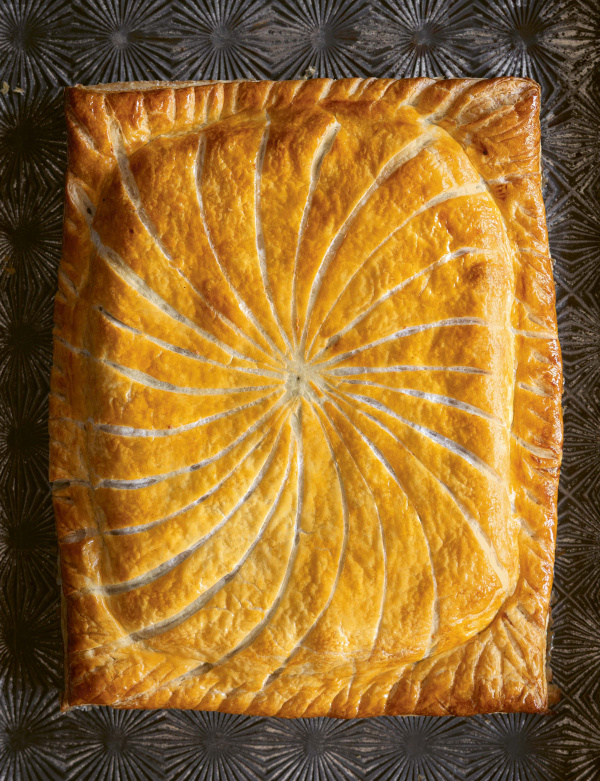
- Give the pastry a final thin coat of egg wash. Using the tip of a sharp knife, lightly score the pastry surface with your choice of decoration. I made lots of curved lines radiating from the centre of the rectangle towards the outer edge. When scoring, do not cut all the way through the dough. (It should feel as though the knife is just scratching the surface. Be at one with the knife.)
- Bake in the preheated oven for 40 minutes, then serve immediately. The filling will be piping hot, but the pastry will be at its very best.


Tell us what you think
Thank you {% member.data['first-name'] %}.
Explore more recipesYour comment has been submitted.