Christmas Loaf Cake
by NigellaIntroduction
 I can’t tell you how long I’ve yearned for a Christmas loaf cake, nor why I’ve come up with one only now. But I won’t waste my time or yours by lamenting the lost years without it; I’d rather concentrate on the happiness that it’s in my life now.
I certainly don’t disavow all my traditionally shaped round Christmas cakes but I’ve always felt that a loaf of fruit cake would cut into the perfect slices, especially pleasing when eaten with cheese (Kirkham’s Lancashire or a good Wensleydale for choice) and this is, indeed, the case – emphatically so. Form alone would not be enough, though: flavour is what food is about, and this little beauty certainly rewards on that front; boosted by brandy and warmly infused with ginger, every slice is a seasonal taste sensation. I’m not saying you couldn’t make it with rum or whisky but, on the basis of my testing and retesting, I came to the conclusion that it was only brandy that gave it the flavour I wanted; ginger needs a partner sprightly enough to stand up to it!
While the recipe below is for a 2lb/900g loaf tin I’ve also used the mixture to make two little 1lb/450g loaves very successfully. (And do see Additional Notes, below.) In theory, I see no reason why you couldn’t halve the mixture to make just one 1lb loaf, but even if you want just one little cake yourself, it feels more in the Christmas spirit to give the other one away as a present.
I can’t tell you how long I’ve yearned for a Christmas loaf cake, nor why I’ve come up with one only now. But I won’t waste my time or yours by lamenting the lost years without it; I’d rather concentrate on the happiness that it’s in my life now.
I certainly don’t disavow all my traditionally shaped round Christmas cakes but I’ve always felt that a loaf of fruit cake would cut into the perfect slices, especially pleasing when eaten with cheese (Kirkham’s Lancashire or a good Wensleydale for choice) and this is, indeed, the case – emphatically so. Form alone would not be enough, though: flavour is what food is about, and this little beauty certainly rewards on that front; boosted by brandy and warmly infused with ginger, every slice is a seasonal taste sensation. I’m not saying you couldn’t make it with rum or whisky but, on the basis of my testing and retesting, I came to the conclusion that it was only brandy that gave it the flavour I wanted; ginger needs a partner sprightly enough to stand up to it!
While the recipe below is for a 2lb/900g loaf tin I’ve also used the mixture to make two little 1lb/450g loaves very successfully. (And do see Additional Notes, below.) In theory, I see no reason why you couldn’t halve the mixture to make just one 1lb loaf, but even if you want just one little cake yourself, it feels more in the Christmas spirit to give the other one away as a present.
Ingredients
Yields: 12-14 slices
- 400 grams mixed dried fruit
- 75 grams glace cherries (halved)
- 125 millilitres brandy
- 75 grams crystallised ginger (roughly chopped)
- 1 clementine (zest and juice)
- 125 grams soft unsalted butter
- 125 grams soft dark brown sugar
- 2 eggs
- 75 grams ground almonds
- 100 grams plain flour
- ½ teaspoon baking powder
- 1 teaspoon ground cinnamon
- 2 teaspoons ground ginger
- Good grating of nutmeg
FOR ICING AND DECORATING
- 450 grams ready to roll marzipan
- icing sugar for rolling
- 1 - 2 tablespoons smooth apricot jam or shredless marmalade
- 450 grams white ready to roll fondant icing
- 3 cups mixed dried fruit
- ⅓ cup candied cherries (halved)
- ½ cup brandy
- ⅓ cup candied stem ginger (roughly chopped)
- 1 clementine (zest and juice)
- 9 tablespoons soft unsalted butter
- ⅔ cup soft dark brown sugar
- 2 eggs
- ¾ cup almond meal
- ¾ cup plus 1 tablespoon all-purpose flour
- ½ teaspoon baking powder
- 1 teaspoon ground cinnamon
- 2 teaspoons ground ginger
- Good grating of nutmeg
FOR ICING AND DECORATING
- 1 pound ready to roll marzipan
- confectioners' sugar for rolling
- 1 - 2 tablespoons smooth apricot jam or shredless marmalade
- 1 pound white ready to roll fondant icing

Method
For the cake
- The day before you want to bake the cake – though it wouldn’t matter if you did this a couple of days before – put the mixed dried fruit and glacé cherries into a saucepan with the brandy. Bring the pan to a bubble, then take off the heat and pour the contents into a bowl. Let cool, then cover and leave overnight.
- The following day, line the bottom and sides of a 2lb/900g loaf tin with a large piece of baking parchment. Just push it down into the tin, and pleat each corner so that the paper sits flat. Then heat the oven to 150°C/130°C Fan/300°F.
- Add the roughly chopped crystallised ginger to the soaked fruits.
- Finely zest the clementine into the mixing bowl in which you will make the cake batter, then turn back to your bowl of soaked dried fruit and squeeze the juice of the now bald clementine into it, and give it a stir.
- Combine the ground almonds, flour, baking powder, ground ginger and grated nutmeg into a (smaller) bowl, and set aside for a mo.
- Now add the butter and sugar to the clementine zest in its mixing bowl and beat, either by hand or, should you be using a free-standing mixer, with the flat paddle attachment, until it’s creamily softened and slightly fluffy. At this point, add the eggs one at time, beating after each addition until it’s completely absorbed.
- Stir in the soaked fruit mixture to combine it thoroughly with the batter, then spoon in the spiced flour mixture, beating and folding until it’s completely incorporated.
- Dollop and scrap this thick mixture into your lined tin, and smooth the top with a spatula. Give the tin a firm rap on the kitchen counter, then put it in the oven to bake for an hour to an hour and 15 minutes; this rather depends not just on your oven, but also the dimensions of your tin. When cooked, an inserted cake tester will come out clean. The top should be set, but it will still feel a little soft; it hardens as it cools.
- Once it’s cooked, leave it on a cooling rack until it’s completely cold. Then remove and discard the lining, and wrap the cake afresh first in baking parchment then in foil, and place in a cake keeper or other air-tight container for at least a couple of days, though you could leave it for up to a month.
For the icing
- Dust a work surface with icing sugar and roll out the marzipan so that it will just cover the top and sides of the loaf cake when draped over, and it is of an even thickness, somewhere in the region of half a centimetre/ quarter of an inch. Even if you’re not a marzipan-lover, this layer is crucial if you’re going to ice the cake, though you could make it a bit thinner.
- Using a pastry brush, paint the loaf cake with the smooth jam or shredless marmalade. Then lift the rolled-out marzipan and cover the cake, pressing and smoothing the marzipan so that it sticks in an even layer covering the top and sides. Trim away the edges at the very bottom of the cake, and then leave unwrapped for the marzipan to dry out for a day or overnight, though if you want to put it in a cake keeper or air-tight container for safety, then do.
- For the final layer, dust a work surface with icing sugar, then patiently roll out the white fondant icing to an even thickness of just under half a centimetre/ quarter of an inch. With a pastry brush, paint the marzipan layer with a little cold water, then drape over the fondant icing as you did the marzipan to cover the top and sides of the cake.
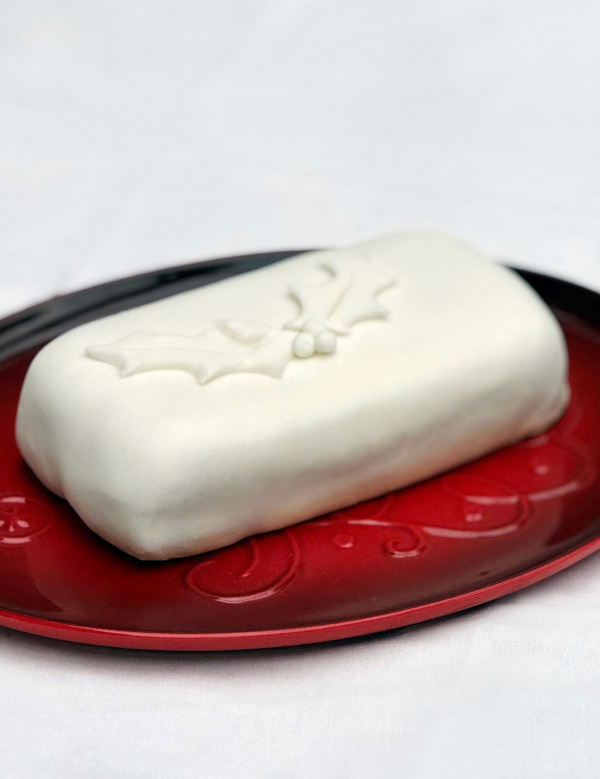
- Using your hands, press gently all over to secure and smooth the icing, and trim the bottom edges of the cake, pressing in well afterwards. Use any leftover icing to decorate the top as you wish. As you can see, I’ve fashioned some holly leaves and rolled little balls of icing to make their berries. Use a little cold water to stick these, or whatever decorative shapes you’ve created, on top of the cake.
- Place the cake on a plate, or keep in an air-tight container, for a day before cutting into it, just to give the icing time to firm up, though you can obviously leave for longer, and see additional notes.
For the cake
- The day before you want to bake the cake – though it wouldn’t matter if you did this a couple of days before – put the mixed dried fruit and glacé cherries into a saucepan with the brandy. Bring the pan to a bubble, then take off the heat and pour the contents into a bowl. Let cool, then cover and leave overnight.
- The following day, line the bottom and sides of a 2lb/900g loaf tin with a large piece of baking parchment. Just push it down into the tin, and pleat each corner so that the paper sits flat. Then heat the oven to 150°C/130°C Fan/300°F.
- Add the roughly chopped candied stem ginger to the soaked fruits.
- Finely zest the clementine into the mixing bowl in which you will make the cake batter, then turn back to your bowl of soaked dried fruit and squeeze the juice of the now bald clementine into it, and give it a stir.
- Combine the almond meal, flour, baking powder, ground ginger and grated nutmeg into a (smaller) bowl, and set aside for a mo.
- Now add the butter and sugar to the clementine zest in its mixing bowl and beat, either by hand or, should you be using a free-standing mixer, with the flat paddle attachment, until it’s creamily softened and slightly fluffy. At this point, add the eggs one at time, beating after each addition until it’s completely absorbed.
- Stir in the soaked fruit mixture to combine it thoroughly with the batter, then spoon in the spiced flour mixture, beating and folding until it’s completely incorporated.
- Dollop and scrap this thick mixture into your lined tin, and smooth the top with a spatula. Give the tin a firm rap on the kitchen counter, then put it in the oven to bake for an hour to an hour and 15 minutes; this rather depends not just on your oven, but also the dimensions of your tin. When cooked, an inserted cake tester will come out clean. The top should be set, but it will still feel a little soft; it hardens as it cools.
- Once it’s cooked, leave it on a cooling rack until it’s completely cold. Then remove and discard the lining, and wrap the cake afresh first in baking parchment then in foil, and place in a cake keeper or other air-tight container for at least a couple of days, though you could leave it for up to a month.
For the icing
- Dust a work surface with confectioners' sugar and roll out the marzipan so that it will just cover the top and sides of the loaf cake when draped over, and it is of an even thickness, somewhere in the region of half a centimetre/ quarter of an inch. Even if you’re not a marzipan-lover, this layer is crucial if you’re going to ice the cake, though you could make it a bit thinner.
- Using a pastry brush, paint the loaf cake with the smooth jam or shredless marmalade. Then lift the rolled-out marzipan and cover the cake, pressing and smoothing the marzipan so that it sticks in an even layer covering the top and sides. Trim away the edges at the very bottom of the cake, and then leave unwrapped for the marzipan to dry out for a day or overnight, though if you want to put it in a cake keeper or air-tight container for safety, then do.
- For the final layer, dust a work surface with confectioners' sugar, then patiently roll out the white fondant icing to an even thickness of just under half a centimetre/ quarter of an inch. With a pastry brush, paint the marzipan layer with a little cold water, then drape over the fondant icing as you did the marzipan to cover the top and sides of the cake.
- Using your hands, press gently all over to secure and smooth the icing, and trim the bottom edges of the cake, pressing in well afterwards. Use any leftover icing to decorate the top as you wish. As you can see, I’ve fashioned some holly leaves and rolled little balls of icing to make their berries. Use a little cold water to stick these, or whatever decorative shapes you’ve created, on top of the cake.
- Place the cake on a plate, or keep in an air-tight container, for a day before cutting into it, just to give the icing time to firm up, though you can obviously leave for longer, and see additional notes.
Additional Information
You can use these ingredients to make 2 x 1lb loaves instead. Neither the amount of marzipan and fondant icing needed per cake, nor the cooking time are appreciably different, though start checking when they’ve had 55 minutes, and presume on needing to buy the same amount of marzipan and icing for each 1lb loaf as you do for a 2lb one.
MAKE AHEAD/STORE:
The cake can be made 1 month ahead.
Ideally, ice the cake 1 week ahead of when you plan to eat it. If you are icing the cake further ahead in time, then allow 2-3 days for the marzipan layer to dry out, before adding the icing layer. Store in an airtight container in a cool, dry place.
Once the cake has been cut, it should last for at least 2 weeks. Store in an airtight container in a cool, dry place.
You can use these ingredients to make 2 x 1lb loaves instead. Neither the amount of marzipan and fondant icing needed per cake, nor the cooking time are appreciably different, though start checking when they’ve had 55 minutes, and presume on needing to buy the same amount of marzipan and icing for each 1lb loaf as you do for a 2lb one.
MAKE AHEAD/STORE:
The cake can be made 1 month ahead.
Ideally, ice the cake 1 week ahead of when you plan to eat it. If you are icing the cake further ahead in time, then allow 2-3 days for the marzipan layer to dry out, before adding the icing layer. Store in an airtight container in a cool, dry place.
Once the cake has been cut, it should last for at least 2 weeks. Store in an airtight container in a cool, dry place.



Tell us what you think
Thank you {% member.data['first-name'] %}.
Explore more recipesYour comment has been submitted.
What 1 Other has said
-
Posted by luciddrum on 21st December 2025
Show more commentsReally nice cake and quick to make. Didn't last long enough to get the icing and marzipan on, although was eaten with chunks of marzipan.
Did a few alterations using Gluten Free Flour, Baking Block and Coconut Sugar to suit restricted diets. Still tasted fantastic.